Assessment of the Impact of Microplastics on the Performance of a Membrane Bioreactor for Wastewater Treatment

2026

Directeur de thèse : Dr. HDR. Monnot Mathias (M2P2)

Co-directrice de thèse : Dr. Isabelle Seyssiecq (M2P2)
Co-encadrants de thèse : Dr. Marie-Julie Dalbe (IRPHE) et Dr. HDR. Cristian Barca (M2P2)


Microplastics (MPs) are defined as particles of synthetic origin with sizes ranging from 1 μm to 5 mm [1]. Due to the chemical additives they contain, their ability to adsorb organic contaminants, and their intrinsic toxicity when degraded into nanoplastics, MPs are considered emerging pollutants of concern for public health and the environment. Several studies have confirmed that wastewater treatment plants (WWTPs) act both as sinks and sources of MPs because of microplastic pollution generated by human activities [2]. Recent studies have shown that membrane bioreactors (MBRs) can represent an effective solution (MP retention > 95%) for wastewater treatment [3,4]. An MBR couples a conventional activated sludge biological process with a membrane, generally immersed in the bioreactor to separate sludge (biomass) from treated water. However, the exact retention mechanisms and the effect of MP accumulation on sludge activity and MBR performance remain poorly understood [5,6]. Indeed, the presence of MPs can significantly influence membrane fouling kinetics. The effects of MPs on MBR performance remain complex and depend on several factors such as concentration, shape, type and size of MPs, as well as MBR operating parameters (hydraulic and sludge retention times, membrane flux, etc.). 
Under conditions close to real operation, this PhD project aims to contribute to a better elucidation of MP retention mechanisms and to evaluate the effect of their accumulation in sludge on MBR performance for urban wastewater treatment in terms of carbon pollution degradation, nitrification efficiency, and water productivity (hydraulic performance). [More informations in the attached file]
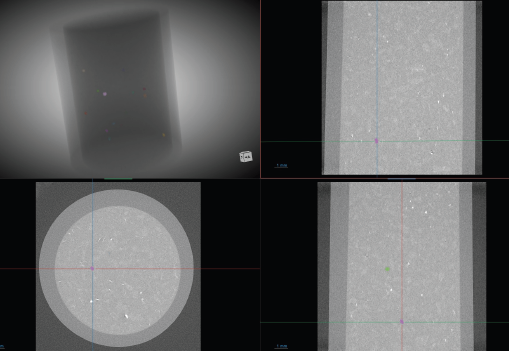
Figure 2 : X-ray microtomography acquisitions of a sample of concentrated sludge containing PS beads of approximately 350 μm (November 2025)
Provisional PhD program (36 months):

M0–M6: Literature review, definition of experimental protocols, and setup of the pilot MBR (biomass acclimation, steady state without MPs).
M6–M12: Campaign 1 (reference without MPs): monitoring of biological (C/N) and hydraulic performances and initial characterization of biofilm and sludge.
M12–M24: Campaign 2: controlled injection of MPs (by type and size), monitoring of fouling, transmembrane pressure, and retention efficiencies (input–output balances, μFTIR [10, 11]). Analysis of MP accumulation in sludge and biofilm; study of impacts on EPS, SMP, flocculation, and biological performance.
M24–M30: Spatio-temporal observations by X-ray microtomography: distribution of MPs in biofilm vs. free sludge, identification of agglomerations and preferential pathways. Modeling and mechanistic interpretation of retention and fouling phenomena as a function of MP properties and operating conditions.
M30–M36: Synthesis of results, completion of thesis writing, and finalization of scientific dissemination.

Profil du candidat :


  • diplômé(e) d’une formation bac+5 en génie des (bio)procédés (master ou ingénieur). 
  • bonne connaissance des opérations unitaires et en particulier des procédés biologique et/ou des procédés membranaires. 
  • compétences en chimie analytique et/ou analyses d’images seraient appréciées. 
  • des qualités d’expérimentateur. 
  • des compétences relationnelles, ainsi que des qualités d’expression et de présentation des résultats 
  • très bonne maitrise de l’anglais (oral et écrit).

Lieu de réalisation du doctorat :


Laboratoire M2P2 Site de l’Arbois : Europôle de l’Arbois, Bat. Laennec, Hall C, Avenue Louis Philibert, 13545 Aix en Provence + déplacements à prévoir au LMA et à l’IRPHE (site de Château Gombert à Marseille) pour analyses. 

...

See more about "Assessment of the Impact of Microplastics on the Performance of a Membrane Bioreactor for Wastewater Treatment"