Traitement des eaux et déchets

Procédés biologiques

Procédés thermiques

Outils et Approches transverses

suite...

Water and Waste Treatment
Présentation

Integrated approach to water and waste treatment and recovery


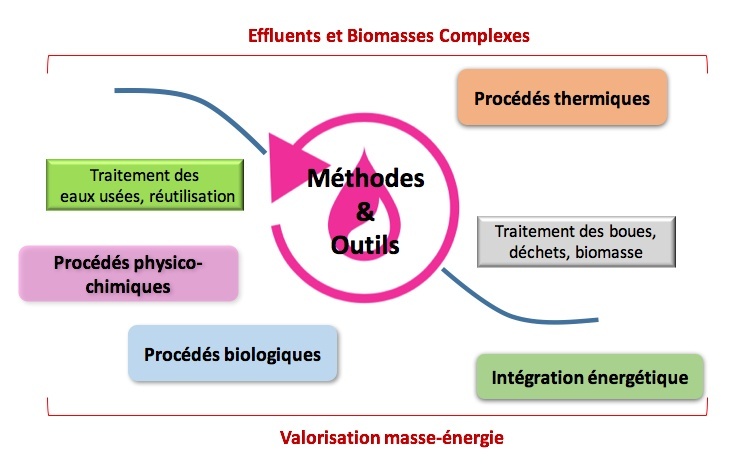
The research of the Water and Waste Treatment team (TED) is organized around an integrated global vision of the treatment and valorization of wastewater, biomass and waste.

This systemic approach is based on a joint experimentation-modeling-simulation approach of processes, to treat, reuse and valorize urban or industrial effluents and biomasses (production of H2, CH4, heat; production of biofuels and platform molecules for chemistry; recovery of nutrients, metals, etc.). It aims to contribute to the major challenges of the 21st century and more particularly to the ecological and energy transitions.

To this end, the team develops multi-scale approaches to the treatment and valorization of effluents and biomasses. At the molecular and cellular scales, the team possesses and develops skills for specific characterizations such as rheology and (bio)-calorimetry. The latter is applied both to the determination of heat related to cellular metabolism and also to high-pressure calorimetry (max 300°C, 60 MPa), the originality of the team concerns the design of specific calorimetric cells. At the reactor scale, studies focus on the development, dimensioning and optimization of biological, thermochemical and physicochemical processes. The characterization of kinetic and transfer quantities leads to the development of dedicated models. These models are used within specific integrative methodologies as soon as two or more processes are coupled. These methods are developed to determine the optimal operation of the coupling and/or the industrial site hosting these processes.


The themes developed in the TED team are articulated around the following three axes:


Pollution control axis

dedicated to the dimensioning of water and waste treatment processes as well as to the understanding of the transfer mechanisms and reaction processes involved.

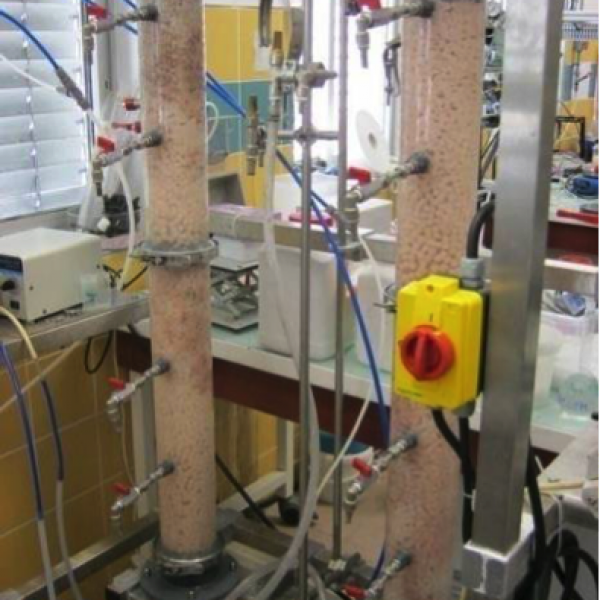
Sub-axes: bioreactors, reactive filters, wet oxidation, rheology, calorimetry, etc.


Valorization axis

in which studies are devoted to the optimization of processes and procedures for the material and/or energy recovery of effluents and waste

Sub-axes: bioH2 and energy carriers from biomass, gasification, hydrothermal liquefaction processes, nutrient recovery, etc.


Integration axis

focused on the study of the coupling of processes developed in the team associated with a flow optimization approach by ad hoc methods.

Sub-axes: process coupling, energy optimization, simulation of processes, etc.

Responsable

  • Maître de Conférences AMU - HDR
    équipe Traitement des Eaux et Déchets
x >

Annuaire personnel permanent

x >

Doctorants, Post-Doctorants et CDD

x >

Equipements

-    Rhéomètre
-    Calorimètre SETARAM C80
-    Spectromètre UV et IR équipé avec une cellule gaz pour mesure on-line continu et ATR
-    Micro-chromatographe gaz
-    Pilote de Gazéification semi Batch (10 gr) (études de faisabilité)
-    Banc de caractérisation de la pollution des eaux (DCO, DBO5, MES, MVS, PO43+, NH4+, NO3- …)
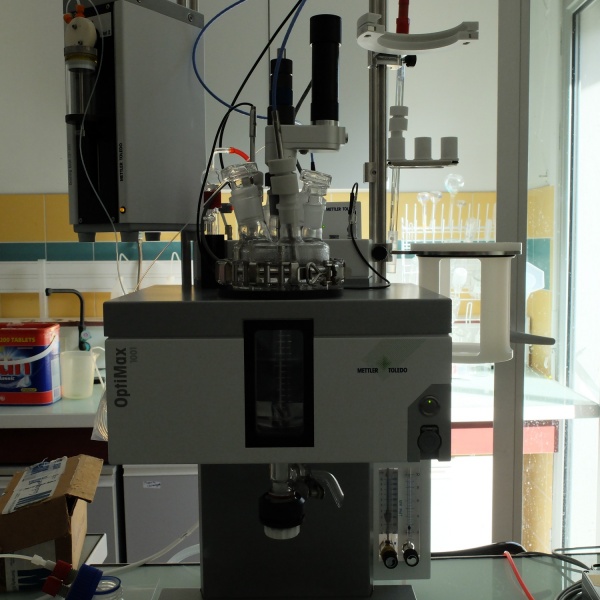
-    Calorimètre de réaction (1 L)
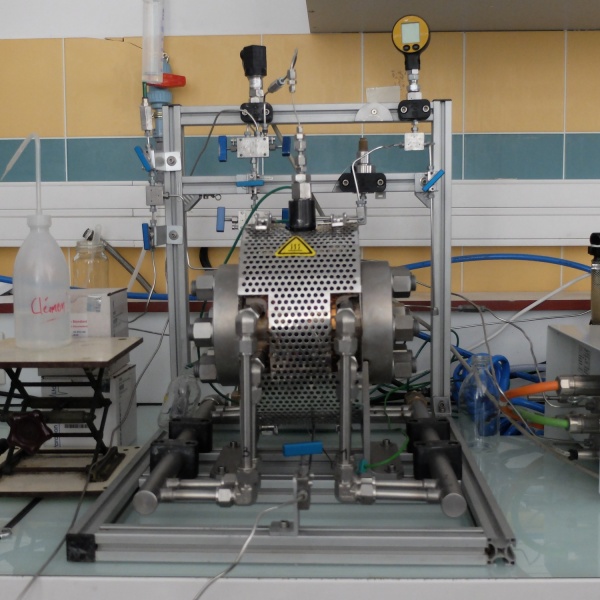
-    Réacteurs hydrothermaux hautes pression et température, batch (200 mL 350°C, 40MPa) et continus (6 L/h, 500°C, 30MPa)
-    Pompes haute pression
-    Bioréacteurs

Partenaires académiques et industriels

Collaborations Internationales avec

Kumamoto University (Japon) / EAN Bogotá (Colombie) / La Sapienza Rome (Italie) / Politecnico di Torino (Italie) / LBGEL-ENIS Sfax (Tunisie)


Collaborations Nationales 

Industrielles :

ENGIE / A3i INOVERTIS / Société du Canal de Provence / Athéna Recherche & Innovation / Earthwake / CMA-CGM

Académiques - Institutionnelles :

Région PACA / Institut de Mécanique et Ingénierie (IMI) / FR Fabri de Peiresc / FR ECCOREV / BIP Marseille / BBF Marseille / CEREGE Aix-en-Provence / INERIS Aix-en-Provence / DEEP-INSA Lyon / LRGP Nancy / LGC Toulouse / Hôpitaux de Marseille

 

Dernières publications de l'équipe

  • Paul Chambonniere, Evita Dollon, Alexandra Dimitriades-Lemaire, Jean-François Sassi, Florian Delrue. Scalable model development of carbon photosynthetic assimilation and partitioning in a green microalga during nitrogen starvation. Bioresource Technology, 2026, 441, pp.133585. ⟨10.1016/j.biortech.2025.133585⟩. ⟨cea-05424045⟩ Plus de détails...
  • Amani Briki, Milos Kacanski, Romain Irague, Audrey Soric. Coupling of biohydrogen and polyhydroxyalkanoates production processes for next-generation biorefineries: process design, optimization and perspectives. Bioprocess and Biosystems Engineering, 2026, ⟨10.1007/s00449-026-03325-7⟩. ⟨hal-05584464⟩ Plus de détails...
  • Emilie Gout, Mathias Monnot, Olivier Boutin, Pierre Vanloot, Philippe Moulin. Prospects of industrial membrane concentrates: treatment of landfill leachates by coupling reverse osmosis and wet air oxidation. Environmental Science and Pollution Research, 2025, 32, pp.16570-16578. ⟨10.1007/s11356-024-32461-4⟩. ⟨hal-04593773⟩ Plus de détails...
  • Carolina Ochoa-Martinez, Cristian Barca, Olivier Boutin, Jean-Henry Ferrasse. Influences of temperature and reaction time on nutrient conversion and metal interactions during hydrothermal treatment of pig manure. Science of the Total Environment, 2025, 958, pp.177853. ⟨10.1016/j.scitotenv.2024.177853⟩. ⟨hal-04967893⟩ Plus de détails...
  • Antonello Tangredi, Cristian Barca, Jean-Henry Ferrasse, Olivier Boutin. Combining process severity and response surface methodology: a comprehensive approach to phosphorus speciation in sewage sludge hydrothermal treatment. Journal of Environmental Management, 2025, 381, pp.125239. ⟨10.1016/j.jenvman.2025.125239⟩. ⟨hal-05039217⟩ Plus de détails...
x >

Rencontres scientifiques

Soutenances de thèses et HDR

11 February 2026
11 décembre 2025 - Valorization of Pig Manure through Hydrothermal Treatment: Investigation of P and N Conversion Dynamics / PhD Defense Carolina Ochoa-Martinez
Doctorante Carolina OCHOA MARTINEZ

Date and location: Thursday, December 11, 2025, at 2:00 PM in the Forum projection room ; Arbois-Méditerranée

Abstract: Global agriculture relies heavily on non-renewable phosphorus (P) reserves and energy-intensive nitrogen (N) fertilizers to sustain crop production. At the same time, intensive livestock farming generates large volumes of liquid effluents rich in organic matter and nutrients, which, if not properly managed, can lead to environmental impacts associated with their discharge. 
To address these challenges, hydrothermal treatment of real pig manure was carried out to investigate the influence of operating conditions on P and N conversion and distribution. Comparative experiments were performed across a wide severity range (107–200 °C, 25–95 min to 300 °C, 10–60 min). The resulting solid, aqueous and oil phases were systematically characterized through physicochemical analyses and sequential phosphorus extractions. 
Results show that more than 90% of P was recovered in the solid phase. The mineralization of organic P and Al/Fe-bound P dissolution into calcium phosphates was identified as the main mechanism governing P retention in the hydrochar. Temperature emerged as the most influential parameter affecting P conversion and speciation, with strong correlations observed between P forms and the availability of metal cations (Ca, Mg, Fe, Al). Dissolved organic nitrogen remained the dominant N fraction in the aqueous phase, highlighting a major limitation in current hydrothermal valorization strategies.

Keywords: Hydrothermal treatment, pig manure, phosphorus speciation, nitrogen transformation, biocrude, process water recirculation, hydrothermal liquefaction, hydrothermal carbonization.

Jury :
Audrey VILLOT                                          Rapportrice,                                                      IMT Atlantique
Magali CASELLAS                                     Rapportrice,                                                      Université de Limoges
Boram KIM                                                 Examinatrice,                                                    INSA Lyon
Stéphan BOSTYN                                      Examinateur,                                                     Université d’Orléans
Olivier BOUTIN                                          Examinateur,                                                     Aix Marseille Université
Jean-henry FERRASSE                            Directeur de thèse,                                            Aix Marseille Université
Cristian BARCA                                        Co-directeur de thèse,                                       Aix Marseille Université